Home Garden
What's the difference between a possum and an opossum?
Content Updated: September 15, 2025
The opossum can be found in rural and urban settings in both the United States and Canada. It is known for being a scavenger, even eating garbage. You may be asking yourself, isn’t an opossum the same thing as a possum—the same animal, just with different pronunciations? As it turns out, this is a common misconception. Learn the difference between a possum and an opossum.
So, is it possum, or opossum?
Before we get into an explanation between possums vs opossums, it’s actually important to understand a little bit of history. That’s because one of these was discovered before the other on completely different continents. In the 17th century, Captain John Smith, who was one of the colonists in the Jamestown colony in Virginia, named the opossum based on an Algonquian word meaning “white beast.” And thus, the opossum we know today got its name.
Over one hundred years later in the late 1700s, different explorers traveled to Australia and New Guinea. There, one of the explorers—a naturalist by the name of Sir Joseph Banks— saw a creature he determined to be part of the “Opossum tribe” described in America. What was the name that this creature was given? Possum.
Opossum vs possum: Differences and similarities
As you can tell from the history of each animal’s origin, the opossum and possum are in fact very different animals altogether (even if they are related). Though “opossum” is sometimes shortened to “possum” in North America, with the two words often being used synonymously, this is technically a misnomer. The proper name for the scaly-tailed creature with a pointed head (that may be baring its teeth) is opossum. So, what's the difference between a possum and an opossum? Keep reading to find out.
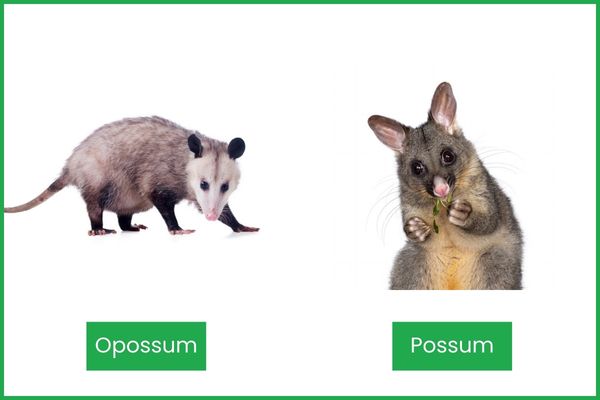
Opossum
Opossums, scientifically known as Didelphis virginiana, are the only native marsupials found in North America.
- Appearance: Opossums are roughly the size of raccoons, measuring about two to three feet long, and have grayish fur. They are also recognizable from their long, pointed snouts and sharp teeth.
- Behavior: Have pouches to carry their young. The young can use their tails to hang upside down, although adults are too heavy to continue this behavior.
- Diet: Opossums are omnivores, feeding on fruits, plants, insects, snakes, and small mammals such as mice and rats.
- Disease risk: They are often believed to carry various parasites and can carry diseases such as leptospirosis, but due to their lower body temperature, they are relatively resistant to rabies.
- Lifespan: In terms of lifespan, opossums typically live about two to four years in the wild, although some can live longer in captivity.
As for keeping them as pets, it is technically possible, but they require specialized care and consideration of their dietary needs, habitat, and social behavior. In some regions, it may be illegal to keep them as pets without a license.
Possum
The brushtail possum, Trichosurus vulpecula, is a marsupial found throughout Australia. Possums belong to the Phalangeridae family, which also includes other marsupials such as cuscuses.
- Appearance: Possums have furry tails, which is how they got the name brushtail possums. Brushtail possums are slightly smaller than opossums, measuring one to two feet long, with shorter and less pointed snouts.
- Behavior: Possums typically give birth to one young at a time, called joeys. They are also nocturnal and tree-dwelling.
- Diet: Like the opossum, they are omnivorous and eat fruit, plants, and insects.
- Disease risk: They carry diseases such as leptospirosis and can be vectors for parasites, including ticks and worms.
- Lifespan: Brushtail possums typically live 8 to 12 years in the wild. With proper care, they can live up to 15 years or more in captivity.
So, when it comes to possums or opossums, there is technically no possum that dwells in the United States, although it is very common to hear the opossum referred to as such.