Education
Asian longhorned beetle (Anoplophora glabripennis)
Learn more about these invasive, wood-boring insects.
Content Updated: October 2, 2025
Key takeaways
- Asian longhorned beetles are an invasive species that can cause significant damage to hardwood trees by eating them.
- If you see an Asian longhorned beetle, it’s best to report it right away, so that measures can be taken to prevent their spread.
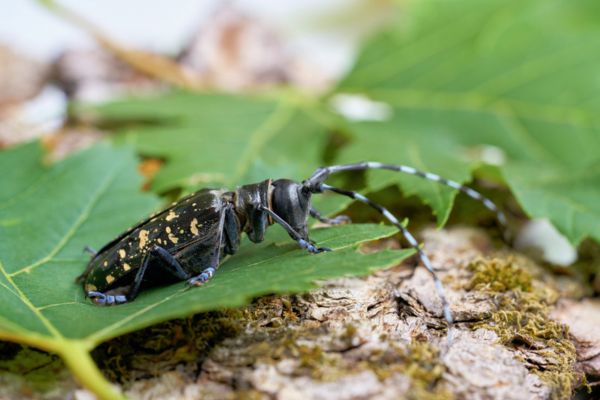
- These beetles are shiny black with white spots, and they have long antennae with black and white bands.
- Their primary target is maple trees, but they’ve been known to feed on other kinds of trees, as well.
Jump to section:
Identifying Asian longhorned beetles
Asian longhorned beetle behavior and habitat
Are Asian longhorned beetles dangerous?
What should you do if you see an Asian longhorned beetle?
The Asian longhorned beetle—also known as the starry sky beetle, the ALB, or the smooth shoulder-longicorn—is an invasive species of insect that has threatened a wide variety of hardwood trees in North America.
They originated in China and Korea, most likely hitching a ride inside solid wood packing material from China to the United States. This beetle was first detected in Brooklyn, New York, in 1996 and has since spread to various states, including New Jersey, Ohio, and Massachusetts.
Identifying Asian longhorned beetles
When it comes to Asian longhorned beetles, here’s what you should look out for:
- Size: Adult beetles of this species are typically 1-1.5 inches in length.
- Color: They are shiny black in color, with white spots around the body.
- Features: These beetles have long antennae with black and white bands.
- Flight: ALBs are relatively weak fliers, but some can still fly as far as 8.5 miles.
The extreme damage caused by these insects is why it’s so important to be able to identify them. By recognizing their appearance, you can report them and help the United States Department of Agriculture put a stop to their spread.
How are Asian longhorned beetles different from native beetles?
As an invasive species, Asian longhorned beetles are capable of extensive damage to both rural and urban areas. If not controlled, their financial, cultural, and ecological impacts have the potential to be catastrophic.
Though Asian longhorned beetles have a distinct appearance, one native beetle they can easily be mistaken for is the white spotted sawyer beetle. Still, the latter has a characteristic white spot below the neck that Asian longhorned beetles lack, so be sure to keep an eye out for that when making identifications.
Asian longhorned beetle behavior and habitat
Adult beetles are most active from early summer to early fall, when the weather is warm. They’re most visible during the morning and afternoon on sunny days, as they'll be resting whenever it's cloudy. You’re likely to see them on trees or migrating short distances from July to August.
Outside their native habitat of eastern Asia, they are most often found in the northeastern parts of the United States. They attack and kill hardwood trees, and the resulting tree deaths cause shifts in nutrient cycling, making them a significant threat to native ecosystems.
Diet and feeding habits
These beetles prefer to feed on maple trees, but they’ve also been found on:
- Alders
- Birches
- Elms
- Sycamores
- Willows
Asian longhorned beetle larvae bore large feeding galleries in trunks and branches, while adults feed on the bark of twigs. The feeding galleries created by larvae are especially dangerous, as high amounts of these tunnels can lead to tree stress, dieback, or even tree death.
Here are some facts about the damage these beetles leave behind:
- Trees being attacked by Asian longhorn beetles often have wilted foliage and canopy dieback.
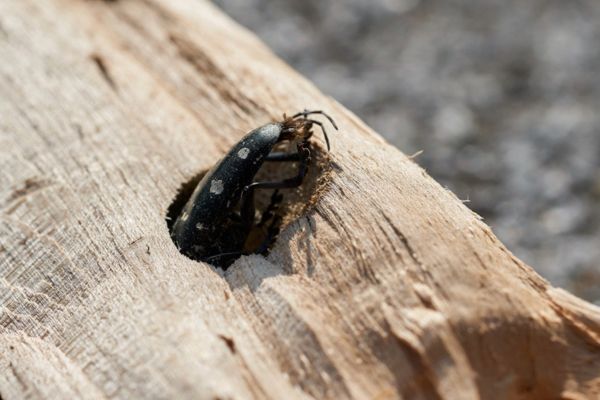
- The bark of attacked trees will have round ⅜ to ½-inch exit holes created by adult beetles emerging from trees beginning in late July.
- Egg-laying sites on the outer part of the bark will be round with half-inch depressions.
- Sap will typically be oozing from the egg-laying sites and exit holes.
- There may be sawdust, or frass, collecting at the base of the tree or on the tree’s branches.
Though Asian longhorned beetles primarily attack living hardwood trees, they can still pose indirect risks to homes and structures when brought indoors, usually through infested firewood.
Life cycle and reproduction
On average, a female Asian longhorned beetle will lay approximately 40-60 eggs in her lifetime. They chew round pits in the bark of trees to lay their eggs, which will then hatch in around 15-50 days, depending on the environmental conditions.
Once the eggs hatch into larvae, they’ll excavate and tunnel under the bark to feed on living tissue through the fall and winter. While in their feeding galleries, larvae will undergo at least five instars over the course of one to two years, before maturing into pupae that turn into adults in summer. Adults then exit the tree by creating large exit holes about 0.4-0.6 inches in diameter.
The exact duration of an Asian longhorned beetle’s lifespan is dependent on a variety of external factors, including food availability and temperature. To survive colder winter months, some individuals can enter diapause and extend their lifespan, living for around two to three years. Otherwise, on average, an adult can live anywhere from 30 to 90 days.
Are Asian longhorned beetles dangerous?
These beetles are not directly harmful to people or pets. They’re not known to bite, poke, or sting, and they’re not poisonous, either. However, the damage they can do to trees and forests means they can create indirect threats if they cause surrounding trees to become unsafe.
The true danger of these insects is the ecological, cultural, and economic harm they can cause through their destruction of hardwood trees—especially maple trees, which, on top of their influence over native ecosystems, can bear both major financial and cultural significance.
What should you do if you see an Asian longhorned beetle?
If you spot one of these invasive pests, the first thing you should do is report it to your local agricultural agency so their presence can be addressed immediately. Be sure to photograph the beetle or the tree damage. If you can, capturing the beetle and freezing it can also be beneficial.
In many cases, areas affected by this invasive beetle must be quarantined to prevent its spread, which is also why early detection is so important. Tree removal and specific insecticides will likely have to be employed to ensure that these insects have been properly dealt with.
Ultimately, this species of beetle requires special treatment and is best left to professionals.