Education
Dung beetles (Scarabaeoidea)
Learn about dung beetles and how they’re important helpers to farmers.
Content Updated: October 23, 2025
Jump to section:
Why do dung beetles roll poop?
How dung beetles benefit farmers?
Can dung beetles reduce E. coli in produce?
Are there dung beetles in the U.S.?
Do dung beetles only eat feces?
Dung beetle life cycle and reproduction
Do I need to get rid of dung beetles?
Dung beetles may seem like a stinky subject, but they are actually fascinating insects that act as nature’s own clean-up crew. In this article, you'll learn how to identify this beetle, learn more about their unique behavior, and see why they’re considered valuable allies to farmers.
Identifying dung beetles
Dung beetles come in a variety of sizes and are actually the strongest insect in the world. You can identify the mighty dung beetle by these characteristics:
- Size: Measuring between one-eighth of an inch to one and one-fourth inches long (about 3 mm to 31 mm).
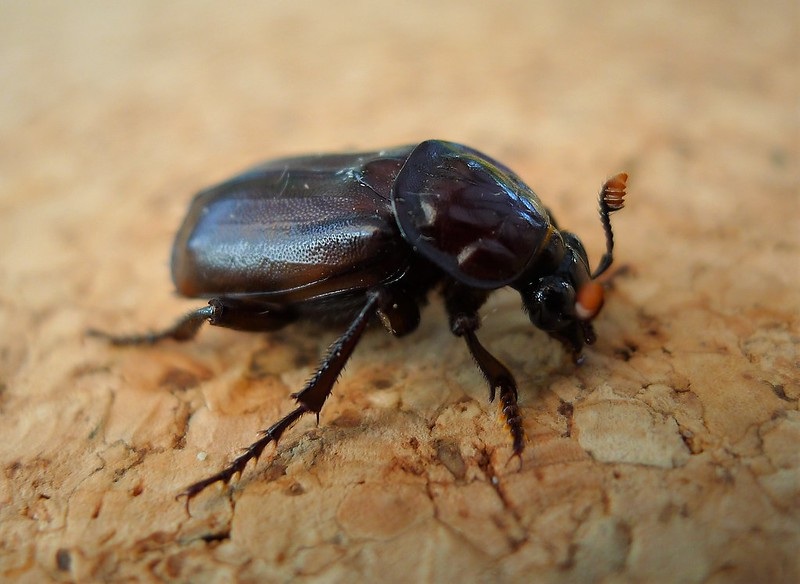
- Color: Black or dark brown, sometimes with a metallic red or green shine.
- Body shape: Rounded body, some species of male dung beetles can have a curved horn on the top of their head.
- Wings: Dung beetles can fly and have wings hidden under a short pair of elytra (wing covers).
Dung beetles are not likely to find their way into most households, but they can be attracted to your property if you have outdoor animals or a barn with animal manure. You can tell if you have an active dung beetle population if there are small holes or tunnels in manure or manure seems to rapidly disappear.
Why do dung beetles roll poop?
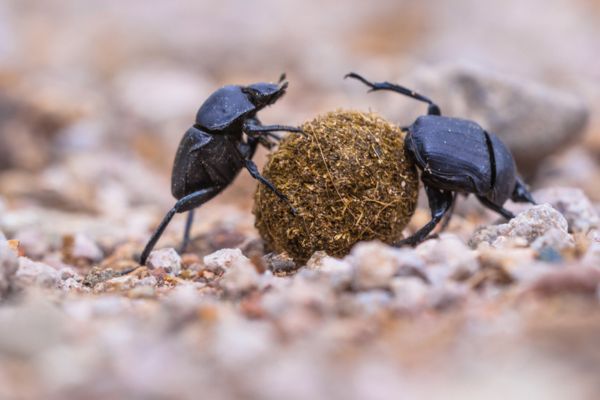
One of their best-known behaviors, dung beetles are known to roll poop for a variety of reasons. These reasons include:
- Reducing competition: Rolling dung away from its source can help dung beetles avoid other competitors.
- Food storage: Dung beetles bury poop to use as a food source for adults and for their young.
- Nesting: Female dung beetles lay their eggs in dung balls, called brood balls, which give larvae a food supply as they grow.
- Mating behavior: Males often shape and roll a dung ball to attract a female. If she accepts, they roll it away together, bury it, and use it as a brood chamber.
How do dung beetles benefit farmers?
Part of the care farmers need to manage for livestock, like cows, chickens, or pigs, is waste management. Excess animal manure can have many negative effects, but a healthy crew of dung beetles can help farmers with clean-up naturally. Some of the benefits of dung beetles for farmers include:
- Reducing flies and parasites: Dung beetles clear our manure and take it underground, limiting exposed manure that can attract flies and worms.
- Minimizing runoff: Rain can channel animal poop into water sources. Dung beetles can help reduce waste that could be a serious pollutant.
- Clearing grazing space: As dung beetles roll away animal poop, it leaves more clean space for livestock to graze in pastures.
- Best for the job: Some farmers use imported dung beetles to break down cow and sheep manure that native insects could not.
In the U.S., the use of the dung beetle to clear pastures is gaining popularity, especially in Midwestern states whose economies rely heavily on agriculture. Currently, the biggest challenge is finding beetles who can survive cold winters, and scoop poop year-round.
Can dung beetles reduce E. coli in produce?
The benefits of the dung beetle and organic farming may not stop with clearing pastures and reducing water pollution. Recently, scientists have been studying dung beetles to see if they can decrease E. coli contamination in food caused by animal droppings left behind near crops. This matters because E. coli outbreaks can have a serious, widespread effect, with some strains that can lead to death.
When it comes to the dung beetle, scientists want to know if their interactions with E. coli–infested scat could reduce the chances of E. coli being transferred to the produce. Some new studies have shown that when dung beetles break down and take away manure, it can limit E. coli’s contact with a plant. This can also potentially reduce the concentration of the bacteria found in the soil, decreasing exposure to this dangerous strain of bacteria.
Are there dung beetles in the U.S.?
Dung beetles can be found in the U.S. and around the world, the only continent without these beetles is Antarctica. They can survive in a variety of habitats from forests to farmlands to deserts, savannas, and mountainous areas. Dung beetles are active from spring to late summer when temperatures are warmer and there is more rainfall.
Do dung beetles only eat feces?
What do dung beetles eat? Dung beetles are coprophagous, meaning they eat feces, but it’s not their only food source. Certain dung species will also scavenge for food sources like decaying vegetation, mushrooms, fruits, and other insects.
Dung beetle life cycle and reproduction
Dung beetles rely on animal poop not just for food, but also for reproduction. Learn about the dung beetle life cycle and how long these bugs can live:
- Lifespan: Dung beetles can live anywhere from six months to three years.
- Reproduction: A female dung beetle will lay her eggs in a dung ball for mating, called a brood ball. Reproduction happens during warmer months, and dung beetle species typically only reproduce once a year.
- Life cycle stages: Dung beetles have a four-stage life cycle: Egg, larva, pupa, and adult.
- Egg: After being laid in the brood ball, eggs can take several days to hatch. Dung beetles tend to lay eggs in lower numbers.
- Larvae: Larvae can be cared for by their mother for up to two months.
- Pupae: Larvae dig underground to begin their transformation in the pupal stage.
- Adult: The pupal stage can take several weeks to months before adults emerge.
Do I need to get rid of dung beetles?
Dung beetles are not invasive or dangerous—in fact, they’re helpful in nature, especially for farmers. Dung beetles are rarely found indoors, so if you do spot beetles in your home, they may be a different type. If you want to learn how to get rid of beetles or just want insight from a professional, our team at Terminix is here to help. If you suspect you have a beetle problem, book a free inspection to help identify and solve pest issues on your property.